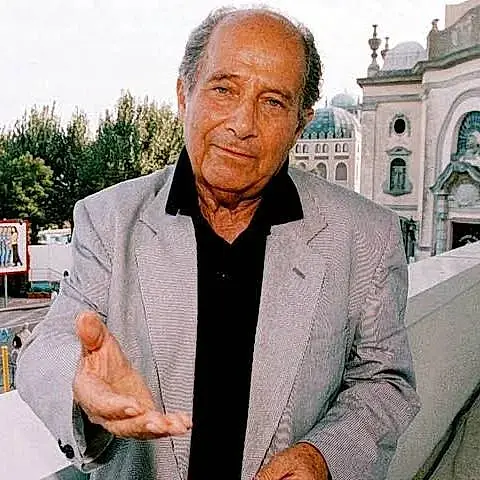
Gillo Pontecorvo
- Born
- 1919-11-19 (age 86)
- Died
- 2006-10-12 (aged 86) · 19 years ago
- Birthplace
- Pisa, Italy
- Occupation
- Film Director, Screenwriter, Composer, Journalist, Documentary Filmmaker, Resistance Fighter, Tennis Instructor
- Spouse
- Maria Adele “Picci” Ziino
- Alma Mater
- University of Pisa
- AKA
- Gilberto Pontecorvo
Career Stats
Career Overview
Gillo Pontecorvo has 1 film credits since 1966 .
- Peak: 1966
Role Distribution
Genre Breakdown
Biography
EARLY LIFE
Gilberto “Gillo” Pontecorvo was born on 19 November 1919 in Pisa into a wealthy, secular Italian Jewish family. His father, Massimo (or Davide Gino Massimo) Pontecorvo, was a textile industrialist whose business was affected by the 1929 economic crisis. His mother was Maria Maroni. He was the fifth of eight children. Notable siblings included Bruno Pontecorvo (nuclear physicist who defected to the Soviet Union in 1950), Guido Pontecorvo (geneticist who settled in Britain), and Paolo (“Poli”) Pontecorvo (engineer). The family was strongly anti-fascist. Pontecorvo studied chemistry at the University of Pisa but left after passing only two exams. He was also a talented tennis player. With the rise of Fascism and the 1938 racial laws, he followed his brother Bruno to Paris, where he worked in journalism and as a tennis instructor. In Paris he encountered leftist intellectuals, artists (including Picasso), and composers (including Stravinsky and René Leibowitz, who taught him music). He was influenced by the Spanish Civil War and the anti-fascist milieu. In 1941 he joined the Italian Communist Party. Using the pseudonym “Barnaba,” he returned to Italy and became a leader of the anti-Fascist Resistance in Milan (1943–1945) and later organized youth and factory workers. After the war he co-edited the communist weekly Pattuglia (1948–1950) and worked as a journalist. He broke with the Communist Party in 1956 over the Soviet suppression of the Hungarian uprising but remained a committed Marxist and man of the Left.
CAREER
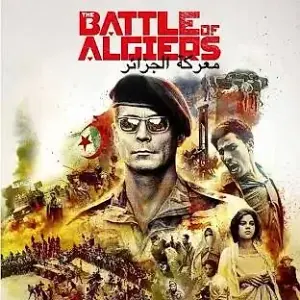
Inspired by Roberto Rossellini’s Paisà (1946), Pontecorvo turned to cinema after the war. He began with self-funded 16mm documentaries in the early 1950s (Missione Timiriazev, Porta Portese, Uomini del marmo, etc.) and worked as an assistant to directors including Joris Ivens and Yves Allégret. Feature films: La grande strada azzurra (The Wide Blue Road, 1957) — his first feature, about a Sardinian fisherman. Kapò (1960) — a Holocaust drama set in a concentration camp; nominated for the Academy Award for Best Foreign Language Film. The Battle of Algiers (La battaglia di Algeri, 1966) — his masterpiece. Co-written with Franco Solinas and co-produced with Algerian involvement (including FLN leader Saadi Yacef, who also acted in the film). Shot in a stark neorealist / newsreel style with mostly non-professional actors (Jean Martin as Col. Mathieu was the main professional). It won the Golden Lion at Venice, received Oscar nominations for Best Director and Best Original Screenplay, and became one of the most influential political films ever made—studied by both revolutionaries and military institutions. Queimada! (Burn!, 1969) — starring Marlon Brando, about a colonial slave revolt in the Caribbean. Ogro (Operación Ogro, 1979) — dramatizing the ETA assassination of Spanish Prime Minister Luis Carrero Blanco. He also directed numerous documentaries and short films into the 1990s and early 2000s (including Return to Algiers, 1992). He composed or co-composed music for several of his films (often collaborating with Ennio Morricone). From 1992 to 1994 he directed the Venice Film Festival. He received the Pietro Bianchi Award at Venice in 2000 and was made a Knight Grand Cross of the Order of Merit of the Italian Republic the same year.
PERSONAL LIFE
Pontecorvo married Henriette (Henriette Niépce) during the war years (around the time of the German occupation of Paris / Saint-Tropez period); the marriage later ended. In the mid-1950s he began a relationship with Maria Adele “Picci” Ziino; they married in 1964 (civil ceremony in Lausanne, later formalized in Italy) and remained together until his death. They had three sons: Ludovico, Marco (who became a cinematographer and director), and Simone. In later life he lived in Rome (including the Parioli district), tended tropical plants, collected glass paintings, composed music, played tennis, and enjoyed scuba diving. He was known for his gentle, witty personality and meticulous approach to filmmaking—he would only direct projects he felt completely committed to, resulting in a relatively small number of feature films.
Pontecorvo’s work is characterized by a rigorous, almost documentary approach to political and historical subjects—anti-colonialism, resistance, and the human cost of struggle. He described The Battle of Algiers as a “hymn… in homage to the people who must struggle for their independence… everywhere in the third world.” Despite critical acclaim, he made relatively few features because of his insistence on complete personal commitment to each project. He remained active in cultural and political discussions until late in life and participated in collective films such as those documenting the 2001 G8 protests in Genoa. He died of congestive heart failure in Rome on 12 October 2006.
Filmography
Key Collaborations
Frequent Producers
Career Timeline
By Decade
Box Office Trend
Sep 18 – Sep 24, 2026- 1
 One Gidi Night▼ -35%₦11,318,134.0086 cinemas
 - 2
 ₦9,780,795.0049 cinemas
 - 3
 ₦6,353,320.0044 cinemas
Subscribe to our Newsletter
Get the latest box office updates, trending movies, and exclusive reviews delivered straight to your inbox.
Popularity Score
Top 100% of African actors