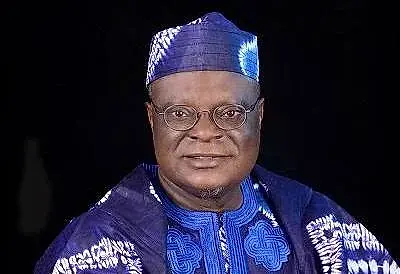
Femi Osofisan
- Born
- 1946-06-16 (age 80)
- Birthplace
- Erunwon, Ogun State, Nigeria
- Occupation
- Professor, Playwright, Poet, Theatre Critic
- Active
- 1966 - Present
- Alma Mater
- University of Ibadan; Sorbonne, Paris
- AKA
- Okinba Launko
Biography
EARLY LIFE
Babafemi Adeyemi Osofisan was born in the village of Erunwon, Ogun State, Nigeria, on June 16, 1946, to Ebenezer Olatokunbo Osofisan, a school teacher, lay reader and church organist, and Phoebe Olufunke Osofisan, a schoolteacher. His last name, Ọ̀sọ́fisan, signifies that his paternal ancestors were artists and artisans who worshipped the god of beauty and ornaments, Ọ̀ṣọ́. Osofisan attended primary school at Ife and secondary school at Government College, Ibadan. He then attended the University of Ibadan (1966–69), majoring in French and as part of his degree course studying at the University of Dakar for a year, and going on to do post-graduate studies at the Sorbonne, Paris.
CAREER
Femi Osofisan is a Nigerian writer and theatre critic, noted for his critique of societal problems and his use of African traditional performances and surrealism in some of his plays. He has written poetry under the pseudonym Okinba Launko. He subsequently held faculty positions at the University of Ibadan, where he retired as full professor in 2011. He is currently a Distinguished Professor of Theatre Arts, Kwara State University, Nigeria. Osofisan is Vice President (West Africa) of the Pan African Writers' Association. In 2016, he became the first African to be awarded the prestigious Thalia Prize by the International Association of Theatre Critics. Osofisan has written and produced more than 60 plays and four prose works: Ma'ami, Abigail, Pirates of Hurt and Cordelia. His prose work, Ma'ami, was adapted into a film in 2011. Several of Osofisan's plays are adaptations of works by other writers.
PERSONAL LIFE
A frequent theme that his drama explore is the conflict between good and evil. He is a didactic writer whose works seek to correct his decadent society. Osofisan in his works also emphasizes gender: his representation of women as objects, objects of social division, due to shifting customs and long-lived traditions, and also as instruments for sexual exploitation; and his portrayal of women as subjects, individuals capable of cognition, endowed with consciousness and will, and capable of making decisions and effecting actions. His inspiration is based on his hometown and his society.
Filmography
No filmography available for this person yet.
Box Office Trend
Oct 30 – Nov 5, 2026- 1
 Agbara Nla: The Return▼ -14%₦39,499,048.0093 cinemas
- 2
 Tele X Zikora▼ -14%₦34,344,147.0097 cinemas
- 3
 Phoenix FuryNew this week₦10,551,146.0084 cinemas
- 4
 Maybe... Maybe NotNew this week₦10,384,485.0069 cinemas
- 5
 Wire TransferNew this week₦7,683,613.0066 cinemas
Subscribe to our Newsletter
Get the latest box office updates, trending movies, and exclusive reviews delivered straight to your inbox.
Popularity Score
Top 100% of African actors