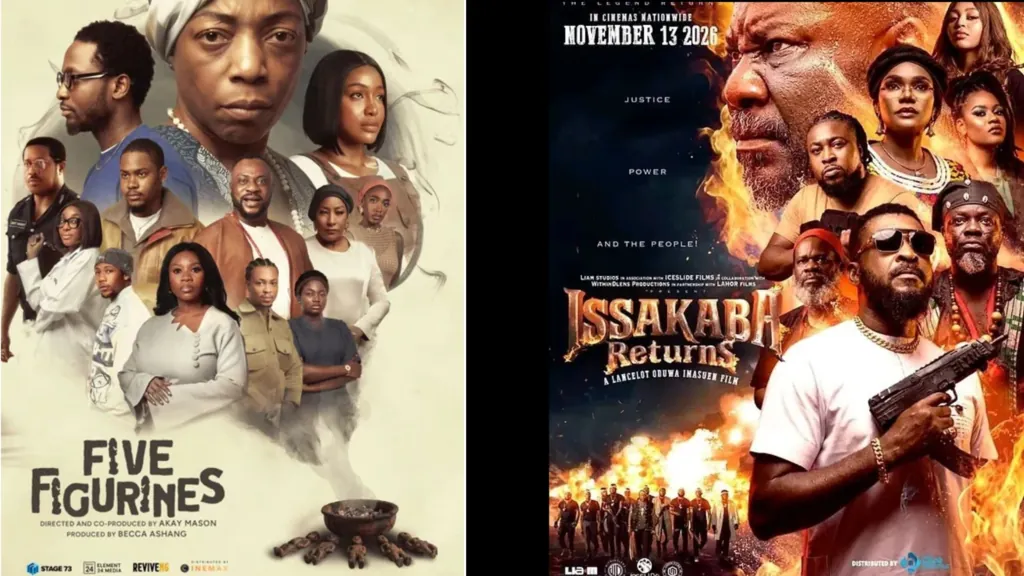
Sam Dede's Ebube is back after 25 years, and Akay Mason's grieving market woman wants her own kind of justice. Both opened on Friday, November 13. Both are asking the same question: what do you do when the system fails you?
I have spent this month writing about justice. First, a courtroom Beyond Blood, the film where a battered lawyer walks into court with school fee receipts and wins. Then the credits — the crew behind Uche Montana's hits, the machine that ships those stories every eight weeks. And now Nollywood has scheduled the follow-up to that conversation itself. On one Friday, two films opened nationwide, and neither of them believes the courtroom is coming to save you. One hands justice to a retired vigilante with a machete and a charm. The other hands it to a mother with five wooden carvings.
Nigeria's cinemas spent the weekend settling scores.
The short answer, for those in a hurry: Issakaba: The Return marketed as Issakaba Returns — is Lancelot Oduwa Imasuen's 2-hour-26-minute sequel to his 2001 vigilante classic, with Sam Dede back as Ebube. Five Figurines is Akay Mason's two-hour murder mystery about a mother avenging her dead son. Both opened in Nigerian cinemas nationwide on Friday, November 13, 2026 Issakaba through the distributor Blue Pictures, Five Figurines through Cinemax. Issakaba is rated 18; Five Figurines is rated 15. And in the early ticket sales reported so far, the mother is beating the machete.
The Friday the box office chose violence
Let's start with the numbers, because they are rude. Early box-office figures compiled by the film database Nollywood.com, as of November 14, put Five Figurines at ₦64.4 million and Issakaba Returns at ₦46.5 million a combined ₦110.9 million from two Nigerian films in their first days of release. These are opening figures, not the final weekend total; the full numbers land early this week. For scale: the previous weekend's number one, Loving Itohan, opened with ₦24.2 million. Box-office trackers noted the clash was on course to produce the biggest double debut two Nollywood films had ever managed on the same weekend.
Read that again with the marketing in mind. One of these films is a 25-year-old franchise with Sam Dede, Chidi Mokeme, Iyabo Ojo, Regina Daniels, BBNaija's Phyna and Mark Angel nostalgia with a merchandising department. The other is an original murder mystery whose biggest star power is a grief-stricken Bimbo Akintola on a poster. The carvings beat the machete by nearly ₦18 million. Nostalgia sold tickets. Curiosity sold more.
There were other new films that Friday like Dear Ajayi, Phoenix Fury but the weekend belonged to these two. And I don't think that's an accident of scheduling. I think it's the same wound, dressed two ways.
Ebube at 61: the legend that was almost too real
If you grew up in the early 2000s, you know the shout. Issakaba! Somebody's VCD, somebody's parlour, and a man in black moving through armed robbers the way harmattan moves through laundry. The original 2001 film directed by Imasuen, produced by the late Chukwuka Emelionwu of Kas-Vid and Moses Nnam, running to four parts was not fantasy to us. It was the news, dramatised. One fan, commenting under Sam Dede's comeback announcement, put it perfectly: "This was our Avengers, Justice league."
Except the source material had a body count. The Issakaba Boys were the Bakassi Boys, born among the shoemakers of Aba's Ariaria market in the late 1990s after armed robbers made the commercial capital of the east unlivable. The spark, according to a 2002 report by the international rights organisation Human Rights Watch, was the killing of a pregnant woman near the market. The traders funded the boys, paid them salaries, gave them a headquarters. Crime fell. People used a phrase I still remember hearing from adults: they could finally sleep with both eyes closed.
Then the story did what Nigerian stories do. Onitsha invited them in "like the arrival of the Messiah," one activist told Human Rights Watch. Anambra State passed a law in August 2000 making them an official state vigilante service. Chinwoke Mbadinuju, Anambra's governor at the time, told journalists that if the armed robbers "buried themselves, they should be exhumed, killed and buried a second time." The famous magic hold a machete over a suspect, and if the blade turns red, he is guilty was, survivors told Human Rights Watch, no magic at all. It was torture until you confessed. In November 2000, the group abducted and killed Eddie Okeke, the man known as Prophet Eddie Nawgu the alleged sorcerer the original film dramatised. He was 43. He left a wife and eight children, the youngest born eight months after his death. By 2002, the federal government was moving to disband the group that state governments had funded.
The film was so close to the truth that the truth came after it. Imasuen told Channels Television this October in an interview reported by Premium Times that the real Bakassi Boys arrested the film's distributor in Aba and stopped Sam Dede himself on the road to Port Harcourt, demanding to know how the filmmakers knew their operations. The group was not fiction, he insisted; the film had followed real events as they happened. "Our fears then were real," he said. "We feared they might come to us."
That is the inheritance Issakaba Returns walks into. The new film, shot in Asaba from 2024, moves the fight to Amangwa, where crime and corruption have overwhelmed the state and a helpless governor does the unthinkable: he asks the defunct Issakaba to come back. The twist in the official synopsis is the interesting part. Ebube, now a husband and a father with more to lose, is determined to prevent their return. The man who was the myth has apparently read the history. Dede returns, with Chinwetalu Agu and Mike Ogundu from the original boys, facing a new generation of criminals and a new generation of faces around him: Mokeme, Iyabo Ojo, Nosa Rex, Regina Daniels, Itele, Phyna, Mark Angel.
The generational maths is brutal. Phyna joked at the Lagos premiere that she was three years old when the original came out. And there is grief underneath this comeback. Diewait Ikpechukwu, who played Odogwu in the 2001 film, died on November 5 at 71 six days before the sequel's premiere. He is not the first: Pete Eneh, Amaechi Muonagor, John Okafor and Zulu Adigwe, all original Issakaba boys, have died in the years since. Sam Dede — who turns 61 on Monday, November 17 — is now one of the last men standing from a film that was nearly a documentary.
The mother, the carvings, and the man who refined his way here
Five Figurines asks the same question from the other end of society. Innocent, a name the director chose deliberately, so you would feel something before the character even speaks is the son a market woman sacrificed everything to educate. He dies. His mother, Ebi, played by Bimbo Akintola, wants answers. The powerful circle around her dead son offers a cover-up instead, because, as Akay Mason told OYA Magazine in an October interview, wealthy families have the resources to shield their children from consequences and the people they harm do not. So Ebi, a Catholic, note, takes her grief to African mysticism. Five carvings. Five suspects. The poster's tagline does the rest: "Some stories are told. Some scores are settled."
The film around the film is almost as good as the premise. Mason fell in love with cinema at 15 watching Ije then the highest-grossing Nigerian film ever made went to South Africa at 17 to study filmmaking, came home to Anthill Studios, and made a short, Money Go Money Come, that about 90 people watched. Elevator Baby (2019) opened the doors; Day of Destiny, Superstar, Love in a Pandemic and Red Circle followed. But the reception of Day of Destiny wounded him he says he became reluctant to touch mysticism again for years. Five Figurines is him walking back into that room on his own terms.
His own terms turned out to be literal. He founded Element24 Media element 24 is chromium, the element used to refine metal; he named the company after the process, not the product and co-produced with Becca Ashang so nobody could hand him a script he didn't believe in. The refinement is documented. Eno Eje's story arrived by Instagram DM; the first one, Mason rejected. It was called Seven Effigies. The first draft ran 145 pages; the shooting script, 105. Three months of development, one month of shooting, four to five months of post-production. He brought Cinemax in as distributor before the shoot advice he now gives every filmmaker and he asked for Bimbo Akintola specifically. She read the script and said yes. "With Five Figurines," he says, "I would say it's a hundred per cent an Akay Mason film." On the press run, he called it the best film he has made.
And look at the names in the margins, because you know I sit through the credits. The screenwriter is Stephen Okonkwo the same Stephen Okonkwo who wrote The Merger on the Montana run of films. In my credits piece I called these writers "the writers nobody interviews." One of them just wrote a cinema murder mystery that out-opened a 25-year-old franchise. The village keeps appearing. The cinematographer is Emmanuel Igbekele Odihiri, and the snake, the eye colours, the visual grammar of the mysticism — Mason's own additions, engineered into the story rather than sprayed on top. Ruggedman is in the cast, surviving his second Akay Mason thriller after Red Circle. Somebody check on him.
The Uche Montana corner
Yes — she is in this one too. Montana plays Grace Bassey, the dead boy's girlfriend, which means the woman who spent last week asking a court what makes a parent is now in a film about a mother who stops asking. Beyond Blood premiered on her YouTube channel on November 7; Five Figurines premiered at Filmhouse IMAX Lekki on November 8 and reached cinemas on November 13. Two films in one week: one free on YouTube, one in cinemas, both about people the system failed. The Trailblazer Award winner at this year's Africa Magic Viewers' Choice Awards is not drifting; she is building a body of work with a single argument. Clinton Joshua — one of the recurring faces in her films is here too, as Richard Bello, one of the five suspects. The same trusted names keep turning up. That is not an accident; it is how her machine works.
Same question, two answers
Here is what I keep turning over. In Beyond Blood, the law worked a judge said out loud that presence, not blood, makes a parent, and I wrote about what that verdict would have meant to the women who raised me. These two films are the other side of that coin. Issakaba is what a community does when it stops believing the state will protect it: it builds its own justice, armed and mystical, and cheers. Five Figurines is what one woman does when she learns that justice has a price list she cannot afford: she builds her own, private and mystical, and we call it a thriller.
Human Rights Watch recorded the contradiction in 2002. A sociology professor it interviewed put it plainly: Nigerians complained about killings without trial, yet supported a vigilante group "totally dedicated to it." Twenty-five years later, we bought tickets to both versions of that sentence in one weekend. The vigilante fantasy and the revenge fantasy are not opposites. They are the same prayer in different registers — let someone answer for this prayed by people who have stopped expecting an institution to answer.
That is why I don't read the ₦110.9 million as a franchise story or a genre story. I read it as recognition, the same thing I argued about Beyond Blood: Nigerian audiences lean forward when the screen tells the truth about their arithmetic. In 2001, the truth was the police cannot save us. In 2026, the truth is money can buy anything, including innocence. Nollywood just filmed both ends of the same quarter-century.
What people are saying and my own verdict is pending
The early word is warm in both directions, though the samples are still small. Five Figurines holds an early audience score of 8.9 out of 10, and one early critic review praised the whole ensemble, singling out Bimbo Akintola. The film reviewer Kelvin Childs Okoroji, writing on Facebook, offered the useful skeptic's take: it is "a story we've seen before," but told from a different angle. Issakaba Returns sits at 7.5, and the skit maker MC Edo Pikun who watched the original as a child says the sequel exceeded his expectations. One early viewer review closed with a proverb that could serve as the whole franchise's epitaph: "A river does not flow down the forest without bringing down trees." Every fight leaves damage behind.
I'll be honest about my own position: my double-bill screening notes and the final weekend numbers are still coming, and I will update this piece with both. Until then, the recommendation is by appetite. If you want the myth the shout, the machete, the generational handover, and a lead actor who was once stopped on the road by the real thing for playing him see Issakaba Returns. If you want the mechanics of grief in a society where the rich purchase outcomes, from a director finally making a film he owns end to end, see Five Figurines. Both are in cinemas nationwide. Neither, I suspect, would exist in a country where the complaint desk works.
Twenty-five years ago, we cheered the boys who cleaned the streets. This weekend we paid to watch a mother count what the cleaning cost. The river keeps flowing down the forest. Nollywood keeps filming the trees.
Frequently Asked Questions
What is Issakaba: The Return (2026) about? A 2-hour-26-minute action-crime sequel to the 2001 classic Issakaba. Crime overwhelms the community of Amangwa and a governor seeks help from the disbanded Issakaba vigilante group but Ebube (Sam Dede), now a husband and father, resists bringing the group back. Directed and produced by Lancelot Oduwa Imasuen.
Is Issakaba based on a true story? Loosely. The Issakaba Boys were inspired by the real Bakassi Boys, a vigilante group formed by Aba market traders in the late 1990s and later backed by south-eastern state governments. Human Rights Watch documented its killings without trial in a 2002 report, and the federal government moved to disband the group that year.
Where can I watch Issakaba Returns? In Nigerian cinemas nationwide from November 13, 2026, distributed by Blue Pictures. It premiered on November 11 at Silverbird Cinemas, Victoria Island, Lagos. Rated 18.
What is Five Figurines (2026) about? A two-hour mystery-thriller. After Innocent the son a market woman sacrificed everything to educate dies suspiciously and a powerful circle covers it up, his mother Ebi (Bimbo Akintola) turns to African mysticism for revenge. Five wooden carvings tie five suspects to the truth.
Who directed Five Figurines? Akay Mason, who also co-produced it with Becca Ashang the first film from his company Element24 Media. Written by Stephen Okonkwo from a story by Eno Eje, and distributed by Cinemax. In cinemas nationwide from November 13, 2026; premiered November 8 at Filmhouse IMAX, Lekki, Lagos. Rated 15.
Is Uche Montana in Five Figurines? Yes as Grace Bassey, the girlfriend of the murdered Innocent, alongside Ini Edo, Odunlade Adekola, Mike Ezuruonye, Ireti Doyle, Chimezie Imo and Clinton Joshua.
Which film opened bigger at the Nigerian box office? Five Figurines, with ₦64.4 million against Issakaba Returns' ₦46.5 million, in early figures reported as of November 14, 2026. Final weekend totals were still being compiled.
How many original Issakaba cast members return? Three: Sam Dede (Ebube), Chinwetalu Agu and Mike Ogundu. New additions include Chidi Mokeme, Iyabo Ojo, Nosa Rex, Regina Daniels, Phyna and Mark Angel.