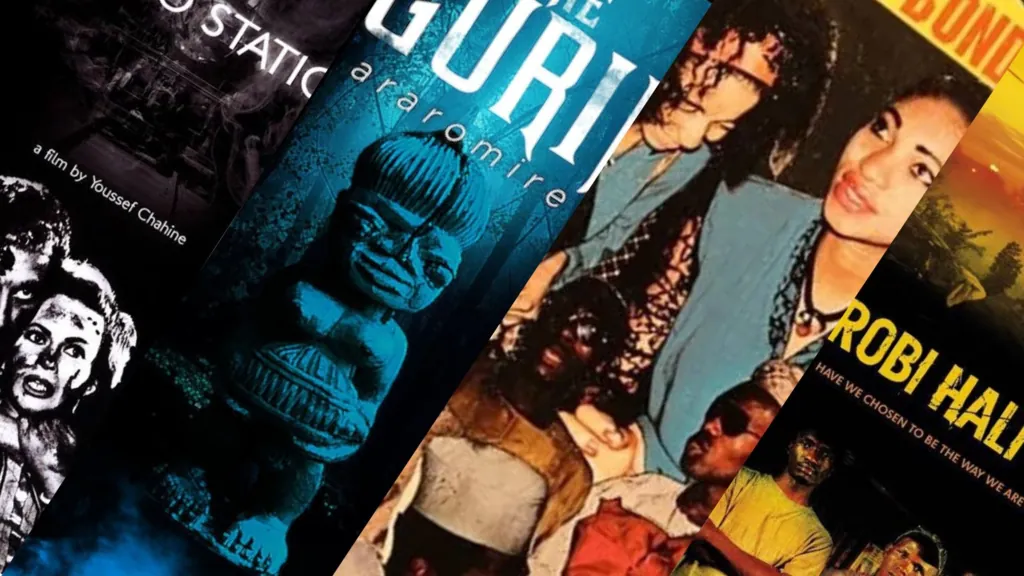
While the current Nollywood box office breaks records and streaming originals dominate the cultural conversation, the foundation of African cinema runs much deeper. Long before international platforms began licensing African content to global audiences, filmmakers across Nigeria, Senegal, Mali, Burkina Faso, Egypt and Algeria were already producing ambitious narratives centred on love, colonialism, migration and identity.
To understand where the industry is heading in 2026, it helps to look at where it has been. The films on this list spans from 1950s Egyptian thrillers to the foundational texts of the Nigerian home-video boom have aged remarkably well. Their ideas remain urgent, and their film-making techniques continue to influence today's directors.
Here are 12 classic African movies worth adding to your watchlist this year. (Note: Every film included here can also be located via the African Movie Database).
1. Cairo Station (1958)
Director: Youssef Chahine
Genre: Thriller, Crime
Language: Arabic
More than six decades after its release, Youssef Chahine’s Cairo Station retains a surprising intensity. Set largely around Cairo's bustling railway terminal, the film follows Qinawi, a newspaper seller whose fixation on a woman named Hanuma gradually spirals into dangerous obsession. What begins as an intimate character study quickly darkens, turning the crowded station into a microcosm of society filled with exploitation, romance and frustration. Blending elements of Italian neorealism with film noir, the film relies entirely on atmosphere and psychological tension rather than spectacle, making it an essential entry point into classic Egyptian cinema.
2. Black Girl (1966)
Director: Ousmane Sembène
Genre: Drama
Language: French
Ousmane Sembène’s Black Girl remains a foundational text in post-colonial African cinema. The film tracks Diouana, a young Senegalese woman who leaves Dakar for France, expecting a better life working for a wealthy French family. Instead, she is systematically stripped of her dignity and treated as little more than a domestic servant. Running just over an hour, the film is a searing examination of race, migration and the deeply unequal dynamics between post-colonial Africa and Europe. For anyone tracing the evolution of African screen storytelling, this is non-negotiable viewing.
3. The Battle of Algiers (1966)
Director: Gillo Pontecorvo
Genre: Drama, Historical
Languages: Arabic, French
Few political thrillers possess the documentary-like urgency of Gillo Pontecorvo’s The Battle of Algiers. Chronicling Algeria's brutal struggle for independence, the film captures the escalating violence between the National Liberation Front (FLN) and French military forces. Rather than framing the conflict through conventional action tropes, Pontecorvo immerses the audience in the claustrophobic reality of bombings, surveillance and urban warfare. The underlying questions regarding occupation, state power and the human cost of resistance remain strikingly relevant to contemporary global conflicts.
4. The Mummy (Al-Mummia) (1969)
Director: Shadi Abdel Salam
Genre: Drama
Language: Arabic
Do not let the English title fool you; Shadi Abdel Salam’s The Mummy (also known as The Night of the Counting Years) is far removed from conventional horror. It is a slow, deeply atmospheric meditation on heritage, identity and generational responsibility. Set in 1881, the narrative centres on an Upper Egyptian clan surviving by looting and selling ancient antiquities. When two young brothers uncover their family's secret livelihood, they are forced to choose between tribal loyalty and the preservation of their country's historical heritage. It is a film that rewards patience, allowing its striking landscapes and moral weight to carry the narrative.
5. Touki Bouki (1973)
Director: Djibril Diop Mambéty
Genre: Drama
Languages: Wolof, French
Djibril Diop Mambéty’s Touki Bouki refuses to behave like an ordinary drama. Set in Dakar, it follows Mory and Anta, two young lovers desperate to escape their circumstances and flee to Paris. Their obsession with leaving drives them toward increasingly reckless schemes, but beneath the kinetic surface lies a sharper critique: is Europe truly the paradise they imagine, and what must be abandoned to reach it? Drawing heavily on French New Wave techniques, the film’s unconventional editing and restless energy capture the disillusionment of post-colonial youth, marking it as one of the most visually distinctive African films of the 1970s.
6. Yeelen (1987)
Director: Souleymane Cissé
Genre: Adventure, Fantasy
Languages: Bambara, Fula
For viewers seeking African fantasy rooted deeply in indigenous mythology, Souleymane Cissé’s Yeelen (Brightness) is essential. Set during the Mali Empire, the narrative follows Nianankoro, a young man possessing supernatural abilities who is relentlessly hunted by his father, Soma, a powerful sorcerer terrified of his son's potential. Guided by his mother, Nianankoro embarks on a perilous journey that forces him to master his spiritual power. Long before the current wave of African mythological fantasy, Yeelen proved that indigenous oral traditions could serve as the foundation for ambitious, epic screen storytelling.
7. Yaaba (1989)
Director: Idrissa Ouédraogo
Genre: Drama, Family
Language: Moore
Where many classic films rely on complex plotting, Idrissa Ouédraogo’s Yaaba draws its power from stark simplicity. The film follows Bila, a 10-year-old boy in rural Burkina Faso who befriends Sana, an elderly woman ostracized by the village and branded a witch. Rejecting the community's prejudice, Bila calls her “Yaaba” (grandmother). When his cousin falls gravely ill, Sana’s traditional knowledge may be the only thing that can save him. It is a quiet, deeply empathetic film that examines superstition and the ease with which communities turn vulnerable people into scapegoats.
8. Tilaï (1990)
Director: Idrissa Ouédraogo
Genre: Drama, Romance
Languages: French, Moore
A companion piece to Yaaba, Idrissa Ouédraogo’s Tilaï (The Law) opens with a devastating homecoming. Saga returns to his village after two years away, only to discover his father has married Nogma, the woman promised to Saga. When the two realize their feelings remain unchanged, they are forced into a direct collision between personal desire and rigid social custom. The resulting tragedy ripples outward, affecting the entire community. Watching Tilaï alongside Yaaba offers a comprehensive look at how Ouédraogo approached tradition, judgment and communal expectations from different angles.
9. Living in Bondage (1992)
Director: Chris Obi Rapu
Genre: Drama, Thriller, Supernatural
Languages: English, Igbo
Any attempt to understand modern Nollywood must begin with Living in Bondage. Directed by Chris Obi Rapu and produced by Kenneth Nnebue, the film follows Andy Okeke, a man whose desperation for wealth leads him into a secret society and the ritual sacrifice of his wife. The riches he acquires quickly give way to guilt, supernatural torment and psychological collapse. Beyond its exploration of greed and materialism, the film's true significance is historical: it is widely recognized as the catalyst for Nigeria’s direct-to-video boom, effectively laying the commercial groundwork for the modern Nigerian film industry.
10. Sankofa (1993)
Director: Haile Gerima
Genre: Drama
Languages: Amharic, Akan, English
Haile Gerima’s Sankofa connects contemporary identity directly to the historical memory of the transatlantic slave trade. The narrative centres on Mona, an African-American model participating in a photoshoot at Ghana's Cape Coast Castle. Upon entering the dungeon, she is transported back in time, assuming the identity of Shola, an enslaved woman on a plantation. Rather than treating history as a closed chapter, Gerima demands that his audience confront the ongoing psychological impact of displacement and the necessity of remembering one's roots. It remains a demanding, uncompromising and deeply rewarding piece of diaspora cinema.
11. The Yacoubian Building (2006)
Director: Marwan Hamed
Genre: Drama
Languages: Arabic, French, English
By 2006, the scale and ambition of African productions had shifted considerably. Marwan Hamed’s The Yacoubian Building demonstrates just how expansive those productions could become. Adapted from Alaa Al Aswany’s bestselling novel, the film uses a single, decaying apartment building in downtown Cairo as a microcosm for Egyptian society. Across its nearly three-hour runtime, the lives of residents from dramatically different social classes intersect, exploring political corruption, religious extremism, class disparity and sexual politics. It stands as one of the most ambitious ensemble dramas in modern Egyptian cinema.
12. The Figurine (2009)
Director: Kunle Afolayan
Genre: Drama, Thriller, Supernatural
Languages: English, Yoruba
Kunle Afolayan’s *The Figurine* (also known as Araromire) serves as a vital bridge between older supernatural storytelling and the emergence of the New Nollywood era. The plot follows two friends who discover a wooden sculpture tied to an ancient goddess, carrying a legend of seven years of immense prosperity followed by seven years of devastating ruin. As the years pass, the line separating mythology, coincidence and human manipulation blurs. By combining high production values with traditional folklore and psychological thriller elements, Afolayan helped redefine what a contemporary Nigerian film could look and feel like.
***
Beyond Nostalgia: Why These Films Matter
Age alone does not secure a film's status as a classic. The projects that endure are those that offer something audiences and filmmakers can continually return to—whether that is a defining moment in industry history, a distinctive directorial voice, or a narrative that outlives the specific political circumstances of its production.
That is the connective tissue between a 1950s Egyptian noir like Cairo Station, a foundational home-video release like Living in Bondage, and an epic Malian fantasy like Yeelen. They were produced across different decades, languages and regions, yet each serves as a time capsule of the society that produced it.
Watching older African cinema is not an exercise in nostalgia. It provides a direct lens into the foundational concerns of African filmmakers—concerns that today’s directors are still actively exploring, albeit with modern technology and budgets. Watching Touki Bouki reveals that African filmmakers were interrogating post-colonial identity and migration decades before those themes became fashionable in global cinematic discourse.
Curating Your Watchlist: Where to Start
There is no requirement to watch these films chronologically. Depending on your cinematic interests, here is where you should begin:
- For Nollywood Historians: Start with Living in Bondage to see the blueprint of the modern Nigerian industry, followed by The Figurine to witness the transition into New Nollywood.
- For Fans of Political and Historical Cinema: The Battle of Algiers and Sankofa are urgent, uncompromising masterpieces.
- For Supernatural and Mythological Storytelling: Yeelen and The Figurine showcase how indigenous folklore translates to the screen.
- For Character-Driven Drama: Ousmane Sembène’s Black Girl is brief but packs a massive emotional and thematic punch.
- For Psychological Thrillers: Cairo Station remains a masterclass in building tension through atmosphere and character obsession.
Good storytelling survives shifts in camera technology, acting styles and audience pacing. As the African film industry continues its rapid expansion in 2026, making room for these foundational texts will give you a much clearer picture of exactly how far the continent's cinema has come.