From the Stage to the Swipe: How the Rise of Skit Makers is Rewiring Nigerian Comedy
For nearly two decades, the trajectory of a successful Nigerian comedian was mapped out in neon lights and stadium banners. You started at open mic nights in Lagos or Abuja, graduated to club gigs, and eventually headlined a massive December comedy concert—think AY Makun’s AY Live or Basketmouth’s Yabifest. The stage was the undisputed altar of Nigerian humor.
Today, that altar has moved. It fits in the palm of your hand, refreshes every fifteen seconds, and relies less on a microphone stand and more on ring lights and trending audio.
The rise of the Nigerian skit maker is not just a trend; it is a fundamental rewiring of the country’s comedy ecosystem. What began as a pandemic-era distraction has matured into a dominant cultural and economic force, fundamentally altering how stories are told, how brands market themselves, and how Nollywood interacts with its audience.
The Democratization of the Punchline
To understand the shift, we have to look at the infrastructure of traditional Nigerian comedy. It was heavily gated. Getting screen time meant passing through the filters of established event organizers and television producers.
The smartphone and the proliferation of relatively cheap mobile data dismantled those gates. Today, a university student in Port Harcourt with a sharp sense of timing and a smartphone has the same distribution power as a comedy veteran with a ten-year career. This democratization has forced a change in the *kind* of comedy being produced.
Traditional stand-up often relied on broad, sweeping observational humor. Skits, by contrast, thrive on hyper-specificity. They are micro-narratives. Whether it is the universally recognized trauma of a "Nigerian Mother" preparing to discipline her child with a slipper, the chaotic absurdity of Lagos Danfo drivers, or the everyday negotiations with an *Agbero* (street tout), skit makers have turned the mundane realities of Nigerian street life into high art. The street has literally taken over the screen.
The New Architects of Humor
This new wave of creators are not just comedians; they are writers, directors, and character actors operating as one-person production houses.
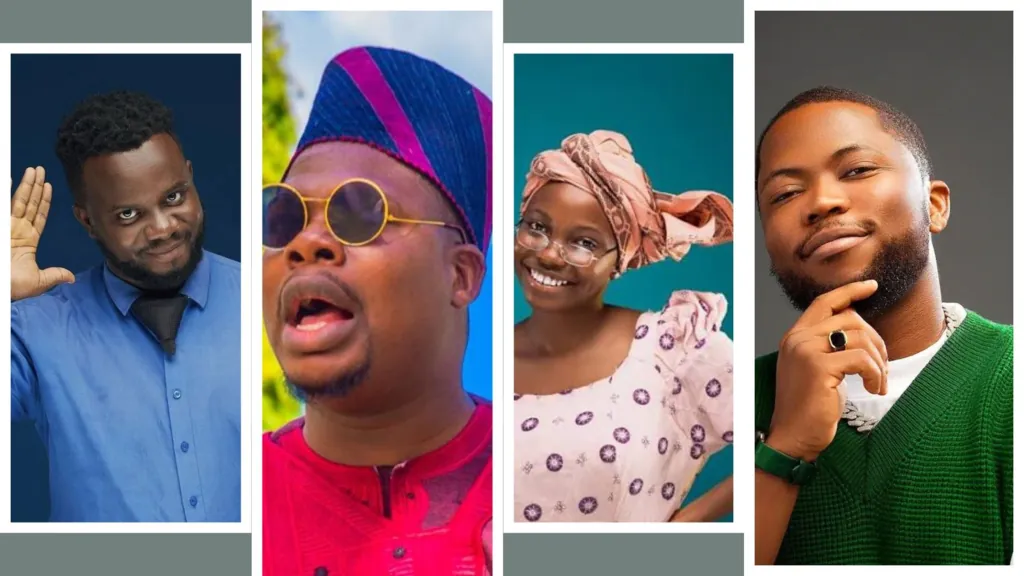
Take Taaooma, for example. In a landscape often dominated by loud, exaggerated physical comedy, she introduced a level of cinematic polish and narrative pacing that rivaled traditional Nollywood short films. By playing multiple generations of characters within a single skit, she proved that the digital space could host complex, character-driven storytelling.
Then there is the phenomenon of Mr Macaroni. His alter ego—a charismatic but deeply flawed "Agbero" and "Sweet Mother"—does more than elicit laughs. It serves as biting social commentary on police brutality, political corruption, and the everyday extortion Nigerians face. By wrapping socio-political critique in the familiar, hilarious packaging of a street encounter, he has made his skits a vital part of the national conversation.
Similarly, Oga Sabinus (Mr Funny) has mastered the art of the silent reaction. By relying heavily on physical comedy and facial expressions, his humor transcends Nigeria’s dense linguistic barriers, allowing him to find massive audiences in neighboring Ghana, Kenya, and across the diaspora.
The Economics: When Skits Become the Product
The financial mechanics of the Nigerian entertainment industry have also pivoted hard toward these creators. In the past, a brand looking to capture the Nigerian youth market would sponsor a comedy concert or buy a TV commercial slot. Today, that budget goes directly to a skit maker’s Instagram or YouTube channel.
Fintech apps, sports betting companies, and telecommunications giants now treat top skit makers not just as influencers, but as essential marketing infrastructure. A well-integrated, hilarious mention of a loan app in a Broda Shaggi or Layi Wasabi skit yields a higher conversion rate than a traditional billboard on the Third Mainland Bridge.
This financial independence has given skit makers immense leverage. They are no longer waiting for Nollywood producers to cast them in supporting, comic-relief roles. Instead, they are executive-producing their own web series and feature-length movies. The recent wave of cinema releases heavily featuring skit makers—from Progressive Tailors Club to the Aki and Pawpaw cinematic universe reboot—signals a changing of the guard. The lines between a "YouTube skit" and a "Nollywood film" are blurring, creating a hybrid cinematic model driven entirely by audience metrics.
A New Cultural Export
Perhaps the most fascinating aspect of the skit-making boom is its geographical reach. Historically, Nollywood movies were Nigeria’s biggest cultural export. But movies require a two-hour commitment. Skits require sixty seconds.
For the massive Nigerian diaspora living in Houston, London, or Johannesburg, these 60-second vignettes are a vital cultural anchor. Hearing familiar Pidgin English, recognizing the exact sound of a NEPA (power grid) transformer blowing, or laughing at the shared generational trauma of Nigerian boarding school experiences provides a daily connection to home. The algorithms of TikTok and Instagram have effectively turned Nigerian street humor into a globally consumed digital product, establishing these creators as unofficial cultural ambassadors.
The Future of the Laughs
Does this mean the death of traditional stand-up comedy? Not necessarily. Just as television didn't kill radio, the skit is simply occupying a different space in the Nigerian entertainment diet. There remains a hunger for the communal, live experience of a comedy concert.
However, the monopoly is broken. The modern Nigerian comedian must now be a hybrid: part stage performer, part digital filmmaker, and part social media strategist. The rise of the skit maker has proven that in Nigeria’s rapidly evolving entertainment landscape, you no longer need a stadium to command an audience. You just need to understand the streets, hit record, and know exactly when to drop the punchline.